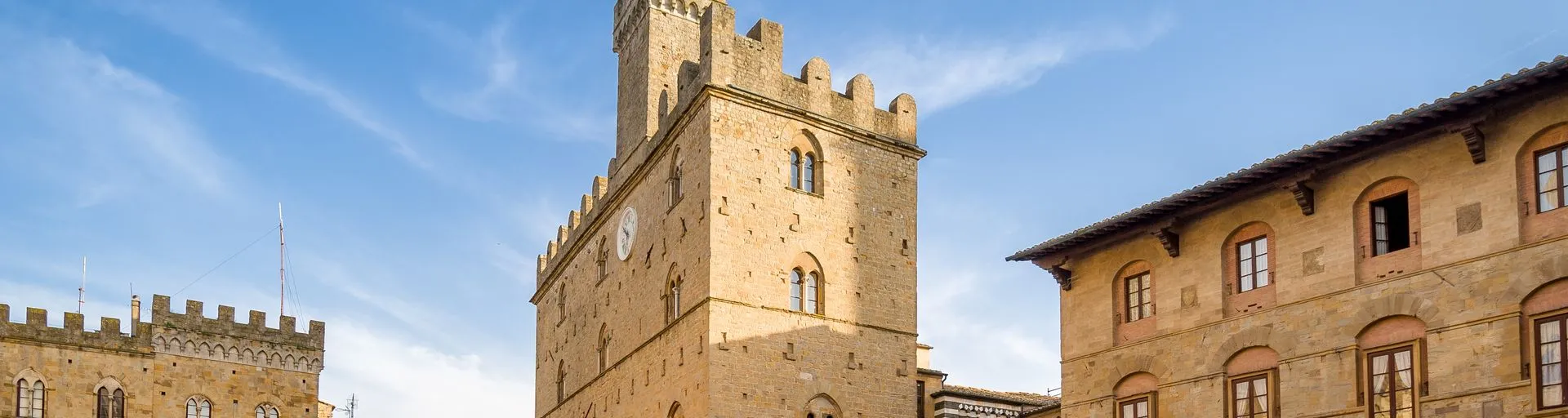
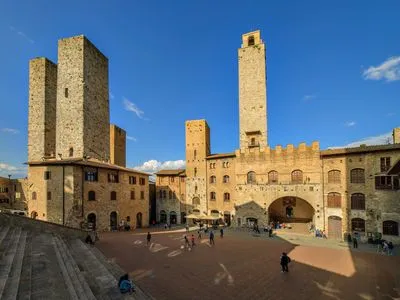
Head towards the golden hills of the Val d’Elsa to reach San Gimignano, one of the best-preserved medieval towns in Europe, listed as a UNESCO World Heritage Site. Known as the “town of fine towers,” it raises fourteen stone silhouettes toward the sky, remnants of rivalries between noble families that once made this small town a symbol of a proud and warlike Tuscany, before falling under the influence of powerful Medici Florence. As you wander through its cobbled streets, between austere palaces and sunlit squares, you will experience the rare feeling that time has stood still here. The panoramas over the vineyards and cypress trees of the Tuscan countryside, visible from the ramparts, are breathtaking. In the afternoon, you will continue to Volterra, a fortress town perched on a rocky spur, dominating the surrounding hills. Here, everything speaks of an even older past: the cyclopean Etruscan walls stand alongside medieval squares, Renaissance palaces, and workshops where artisans still work alabaster by hand, just as their ancestors did two thousand years ago.
PLEASE NOTE
Head towards the golden hills of the Val d’Elsa to reach San Gimignano, one of the best-preserved medieval towns in Europe, listed as a UNESCO World Heritage Site. Known as the “town of fine towers,” it raises fourteen stone silhouettes toward the sky, remnants of rivalries between noble families that once made this small town a symbol of a proud and warlike Tuscany, before falling under the influence of powerful Medici Florence. As you wander through its cobbled streets, between austere palaces and sunlit squares, you will experience the rare feeling that time has stood still here. The panoramas over the vineyards and cypress trees of the Tuscan countryside, visible from the ramparts, are breathtaking. In the afternoon, you will continue to Volterra, a fortress town perched on a rocky spur, dominating the surrounding hills. Here, everything speaks of an even older past: the cyclopean Etruscan walls stand alongside medieval squares, Renaissance palaces, and workshops where artisans still work alabaster by hand, just as their ancestors did two thousand years ago.
PLEASE NOTE